












Program Review
This 6-week program is a Practitioner & Application (Tier 2) course designed to transition professionals with 2-5 years of experience (S&OP Managers, Demand Planners, Finance Business Partners) from traditional planning roles into strategic Integrated Business Planning (IBP) leaders.
Core Focus: One Number Principle and Financial Alignment
The program focuses on mastering the “One Number” discipline—aligning operational execution with the organization’s strategic financial goals by bridging the gap between operational planning and financial strategy.
Key Skills Mastered:
| Skill Focus | Description |
| The IBP Framework | Understanding the Oliver Wight Maturity Model and the 5-Step Monthly Cycle required for the cultural shift toward “One Number” planning. |
| The One Number Discipline | Learning to interpret P&L statements and translate operational volume changes (units/cases) into financial impact (revenue margin), moving beyond basic spreadsheet balancing. |
| Supply Review & Integration | Mastering operational calculations like Rough Cut Capacity Planning (RCCP) and the mechanics of converting operational units to currency to identify and manage the “Budget Gap.” |
| Decision-Making | Practicing Scenario Planning (Best/Worst Case) and mastering executive communication techniques required for the final decision-making forum (Integrated Reconciliation & MBR). |
Capstone Simulation:
The Capstone Project is a “Crisis MBR Simulation” where the participant is given a high-stakes dataset with a significant budget gap. The participant must design, defend, and align a recovery scenario to an executive board.
Detail | Information |
Target Roles | S&OP/IBP Managers, Demand Planners, Finance Business Partners |
Prerequisites | Functional knowledge of supply chain basics and intermediate Microsoft Excel proficiency. |
Program Review
This 10-week program is an Executive Diploma designed exclusively for Finance Leaders (CFOs, VPs of Finance, Heads of FP&A) who seek to transform Integrated Business Planning (IBP) from a supply chain process into the most powerful Enterprise Performance Management (EPM) tool in the C-Suite.
Core Focus: Volume-to-Value Architecture, Continuous Planning, and Financial Governance
The program skips operational basics and dives straight into the financial architecture needed to translate operational signals into P&L reliability, cash flow predictability, and shareholder value, moving the organization away from a static Annual Budget.
Key Skills Mastered:
Skill Focus | Description |
Volume-to-Value Architecture | Learning to build the “Rosetta Stone” that translates operational metrics (cases, pallets) into Revenue, Margin, and Cash, designing the drivers that automate the connection between the Supply Chain plan and the Financial Forecast. |
Dynamic Budgeting & Risk | Implementing “Continuous Planning” cycles to replace the static Annual Budget, allowing for agile capital allocation and rigorous stress-testing of the P&L against supply chain risks. |
Technical Integration | Mastering the mechanics of financializing the plan by integrating IBP data directly into the 3-Statement Model (P&L, Balance Sheet, Cash Flow) and managing Price/Volume/Mix variance. |
Governance & Decision Rights | Structuring the Integrated Reconciliation review to ensure that by the time numbers reach the Executive MBR, the debate is about strategic gap closing, not data validation. |
Cultural Transformation | Transforming FP&A teams from “Scorekeepers” into active IBP participants who challenge commercial assumptions (The Finance Business Partner role). |
Capstone Experience:
The Capstone is the Board Defense, where participants analyze a complex, failing business scenario, construct a financial turnaround strategy, and defend it live before a panel of industry experts acting as the Board of Directors. The final delivery includes an Executive Policy Paper outlining the transition to Dynamic Budgeting.
Detail | Information |
Target Roles | CFOs, VPs of Finance, Heads of FP&A |
Accreditation | CPE Credit Eligible (CPA CIMA aligned) |
Program Review
This 8-week program is a Leadership Diploma designed for IBP Project Leads, Change Management Consultants, and HR Business Partners who are responsible for the human and organizational factors in an Integrated Business Planning (IBP) rollout.
Core Focus: Behavioral Engineering and Organizational Adoption
The program is dedicated to the behavioral engineering of IBP adoption, teaching leaders how to dismantle silos, manage resistance, and build a culture where the radical transparency required for IBP success is celebrated rather than punished.
Key Skills Mastered:
Skill Focus | Description |
Psychology of Planning | Understanding the Behavioral Economics behind planning biases, such as “Sandbagging” (Sale’s under-calling) and hoarding inventory, and how to design processes that encourage “Bad Early.” |
Stakeholder Engineering | Learning to map the political landscape of the organization to identify and influence Champions, Fence-Sitters, and Detractors, and build a “Guiding Coalition” to drive the transformation. |
Communication Architecture | Crafting targeted, function-specific narratives using the “WIIFM” (What’s In It For Me) analysis to ensure the vision resonates with Sales, Finance, and Operations. |
Sustaining the Change | Designing incentives and aligning KPI to ensure the new IBP behaviors stick and are reinforced long after the initial system Go-Live. |
Certification Deliverable:
The final Capstone is the completion of a customized Change Management Playbook specific to the participant’s organization’s IBP rollout, including a stakeholder map, communication timeline, resistance management plan, and training curriculum.
Detail | Information |
Target Roles | IBP Project Leads, Change Management Consultants, HR Business Partners |
Prerequisites | Foundational understanding of IBP concepts. |
Program Review
This 5-week program is a Mastery of Usage course designed for Supply Chain Planners and Digital Transformation Leads whose companies are migrating to or utilizing the o9 Solutions platform.
Core Focus: Enterprise Knowledge Graph (EKG) and AI-Driven Planning
The program trains practitioners to move beyond linear spreadsheets by mastering the o9 Enterprise Knowledge Graph (EKG), the “Digital Brain”—to leverage AI/ML forecasting, run complex constraint solvers, and manage scenarios in real-time.
Key Skills Mastered:
Skill Focus | Description |
Think in “Graph” | Learning to visualize the supply chain as a network of nodes and edges using the Enterprise Knowledge Graph (EKG) for multi-dimensional analysis, enabling visibility into hidden connections and complex network relationships. |
AI, Demystified | Learning how to interpret and trust the AI by using Demand Sensing to incorporate external drivers (weather, mobility, economic data) into forecasts, moving beyond simple history-based statistical models. |
Live Simulation & Solving | Gaining hands-on experience in a Live o9 Sandbox Environment to manage a full monthly cycle, including running the Heuristic vs. the Optimizer and conducting Root Cause Analysis to visualize bottlenecks. |
Control Tower & Scenarios | Building real-time “What-If” scenarios and performing Gap-to-Budget analysis to facilitate executive decision-making. |
Certification Deliverable:
The final Capstone Project, “The Disruption,” simulates a supply chain disruption (e.g., port strike). The participants must use the o9 Solver to model three recovery scenarios, compare their financial impact, and recommend a course of action within the tool.
Detail | Information |
Target Roles | Supply Chain Planners, Digital Transformation Leads, Super Users |
Prerequisites | Strong understanding of general planning concepts (S&OP). |
Program Review
This 8-week program is a Strategy & Leadership Diploma designed for Product Managers, Supply Chain Leaders, and Marketing Directors who are responsible for ensuring every SKU earns its place on the shelf and managing overall portfolio profitability.
Core Focus: SKU Rationalization, NPI Governance, and Complexity Cost
The program focuses on teaching the strategic discipline required to act as the “Portfolio Manager” of the business, bridging the gap between Marketing and Supply Chain to eliminate the “Long Tail” syndrome (where 80\% of complexity generates only 20% of revenue).
Key Skills Mastered:
Skill Focus | Description |
The Art of the “Kill” (Rationalization) | Learning to perform Pareto Analysis and GMROI (Gross Margin Return on Inventory) calculations [Image of Pareto analysis (80/20 rule) in SKU inventory to identify “Zombie Products” and the negotiation strategies required to successfully phase them out (End of Life EOL strategies). |
Launch Discipline (NPI) | Designing rigorous Stage-Gate processes that ensure inventory, capacity, and master data are ready before the commercial launch, preventing the costly “Launch and Expedit” cycle. |
Cost of Complexity | Moving beyond simple P&L to calculate the “True Cost of Complexity”—quantifying the hidden costs of changeovers, short production runs, and warehouse density. |
Lifecycle Management | Applying strategic tools like the BCG Matrix and visualizing the Product Lifecycle Curve to determine the correct strategy (Invest, Maintain, or Harvest) for each product category. |
Certification Deliverable:
The final Capstone Project, “The Tail Cut,” requires the participant to analyze a raw dataset of 10,000 SKU, identify the bottom 20% of value destroyers, calculate the operational savings of delisting them, and craft a Board-level Proposal to rationalize the portfolio.
Detail | Information |
Target Roles | Product Managers, Supply Chain Leaders, Marketing Directors |
Prerequisites | Understanding of basic P&L structures. |
Program Overview
The Executive Certificate in Strategic Innovation & Lean Leadership is a Tier 4 (Advanced Executive & Strategic) program designed for senior leaders responsible for both operational performance and long-term growth. It equips executives with advanced frameworks to integrate Lean operational excellence with strategic innovation, enabling organizations to excel in today’s business while deliberately building tomorrow’s competitive advantage.
Core Focus
Key Skills Mastered
Certification Deliverable
Executive Certificate in Strategic Innovation & Lean Leadership
Awarded upon successful completion and defense of an executive-level dual strategy and innovation blueprint.
Target Roles: CEO, COO, Chief Innovation Officer, Chief Strategy Officer, Executive Vice Presidents, senior P&L leaders
Prerequisites: Significant executive experience; strong foundation in Lean and/or strategic management; organizational sponsorship recommended
Duration: 7 weeks (85 instructional and executive coaching hours)
Program Overview
The Certified Lean Six Sigma Green Belt (CLSSGB) is a Tier 2 (Specialized & Applied) certificate that prepares professionals to lead mid-sized, data-driven improvement projects using the DMAIC methodology. The program combines Lean waste elimination with Six Sigma variation reduction, enabling participants to independently deliver measurable process, quality, and cost improvements or support larger Black Belt-led initiatives.
Core Focus
Key Skills Mastered
Certification Deliverable
Certified Lean Six Sigma Green Belt (CLSSGB)
Awarded upon successful completion of all DMAIC assessments and one live, sponsored improvement project with verified results.
Target Roles: Process Engineers, Quality Analysts, Team Leaders, Department Managers, Analysts, and high-potential professionals
Prerequisites: Foundational Lean or CI knowledge, basic Excel proficiency, and manager sponsorship for a Green Belt project
Duration: 4–6 months (90 instructional hours plus project work)
Program Overview
The Operational Excellence Professional (OEP) Certificate is a Tier 2 (Specialized & Applied) program designed for professionals who lead and manage multiple continuous improvement initiatives across functions. The program develops the capabilities required to act as an internal consultant or OpEx project leader by integrating Lean, Six Sigma, and Business Process Management (BPM) into a cohesive execution and governance framework.
Core Focus
Key Skills Mastered
Certification Deliverable
Certificate of Operational Excellence Professional (OEP)
Awarded upon completion of applied assignments, facilitation simulation, and a comprehensive certification exam demonstrating integrated OpEx capability.
Target Roles: Continuous Improvement Specialists, Process Managers, Internal Consultants, CI-focused Project Managers, and functional efficiency leaders
Prerequisites: Foundational Lean or Six Sigma knowledge (Yellow/Green Belt level), experience leading at least one improvement project
Duration: 12 weeks (75 instructional hours)
Program Overview
This Tier 3 (Expert & Leadership) certificate is designed for senior leaders who must move from executing Lean initiatives to architecting and sustaining a Lean enterprise. The program focuses on strategic alignment, enterprise-wide value stream design, and the establishment of a robust Lean Management System (LMS) that embeds continuous improvement into daily leadership and governance practices.
Core Focus
Key Skills Mastered
Certification Deliverable
Certificate of Lean Operations Management and OpEx Strategy
Awarded upon successful completion of a Hoshin Strategy (X-Matrix), Lean Management System design and audit, and a multi-year Lean deployment roadmap aligned to business strategy.
Target Roles: Operations Directors, Plant Managers, Senior CI/OpEx Managers, VPs of Operations/Manufacturing/Services, and enterprise transformation leaders
Prerequisites: Advanced Lean knowledge (Lean Practitioner/Green Belt level) and proven experience leading cross-functional teams; executive sponsorship recommended
Duration: 8 weeks (85 instructional hours)
Program Overview
This Micro Degree prepares senior leaders to design, implement, and sustain enterprise-wide Operational Excellence programs. Combining Lean, Six Sigma, and Business Process Management, participants gain a strategic, quantitative, and leadership-oriented understanding of OpEx, enabling systemic transformation and measurable business impact.
Core Focus
Key Skills Mastered
Certification Deliverable
Micro Degree of Science in Operational Excellence
Awarded upon successful completion and defense of strategic artifacts, case studies, and a capstone project.
Target Roles: VP of Continuous Improvement, COO, Global Head of Business Transformation, Executive Consultant
Prerequisites: Lean Six Sigma Black Belt (or equivalent); experience leading complex cross-functional projects; executive sponsorship for capstone
Duration: 12 weeks (100 instructional hours)
Program Overview
The Certified Lean Six Sigma Black Belt (CLSSBB) is a Tier 3 (Expert & Leadership) program designed for experienced professionals who lead high-impact, cross-functional continuous improvement initiatives. The program builds advanced capability in Lean waste elimination and Six Sigma variation reduction, enabling participants to deliver strategic, data-driven transformation with measurable financial results and to mentor Green Belts across the organization.
Core Focus
Key Skills Mastered
Certification Deliverable
Certified Lean Six Sigma Black Belt (CLSSBB)
Awarded upon successful completion of exams and a live, sponsor-approved Capstone Project demonstrating verified financial impact.
Target Roles: Continuous Improvement Managers, Quality & Process Excellence Leaders, Operations Directors, Senior CI Professionals
Prerequisites: Lean Six Sigma Green Belt certification (or equivalent), manager sponsorship for a Black Belt project, basic statistical competency
Duration: 6 months (110 instructional hours plus project work)
Program Overview
A foundational program introducing the essential concepts, technologies, and principles of Industry 4.0. Participants gain a clear understanding of how IoT, Cyber-Physical Systems, Cloud Computing, and Data Analytics enable smart factories, real-time visibility, and digitalized operations. The program prepares learners to participate effectively in early-stage digital transformation and Lean 4.0 initiatives.
Core Focus
Key Skills Mastered
Certification Deliverable
Scenario-Based Industry 4.0 Assessment (50%)
A final applied case requiring participants to identify suitable Industry 4.0 solutions for an operational challenge and justify their recommendations.
Passing score: ≥70%.
Target Roles: Production Supervisors, Maintenance Technicians, Quality Analysts, Entry-Level Engineers, IT Support Staff, and professionals participating in digitalization or continuous improvement initiatives.
Prerequisites: None. (Basic computer literacy recommended).
Duration: 4 Weeks, 40 instructional hours (Approx. 10 hours per week).
Program Overview
A foundational, non-technical program designed to build a shared understanding of Digital Transformation (DX), its strategic drivers, business impact, enabling technologies, and the organizational conditions needed for success. Participants learn how DX reshapes customer experience, operations, and business models, and how to apply maturity frameworks to assess readiness and guide early-stage transformation.
Core Focus
Key Skills Mastered
Certification Deliverable
Final Maturity Assessment Report (60%):
A practical evaluation of the participant’s organization or unit using a Digital Maturity Model, highlighting priority gaps and top recommended strategic actions.
Passing score: ≥70%.
Target Roles: Business Managers, Functional Leaders, Project Managers, Strategy Analysts, and professionals participating in digital or organizational change initiatives.
Prerequisites: None (Business acumen and interest in strategic transformation concepts are recommended).
Duration: 4 Weeks (40 instructional hours -Weekly workload: ~10 hours).
Program Overview
A highly technical program designed for engineers and manufacturing IT professionals responsible for designing, deploying, and securing end-to-end IIoT solutions in Smart Factory environments. Participants gain hands-on mastery of IIoT architecture, connectivity protocols, edge computing, OT cybersecurity, and data pipeline design—moving from conceptual understanding to real industrial deployment capabilities.
Core Focus
Key Skills Mastered
Certification Deliverable
Final Applied Design Project (60%):
A complete End-to-End IIoT Solution Architecture for a complex industrial use case, including data flows, protocol selection, security design, and deployment roadmap.
Passing requires ≥75%.
Target Roles: IIoT Architect, Smart Factory Engineer, OT Cybersecurity Specialist, Automation/Controls Engineer, Manufacturing IT Professional, Digital Transformation Technical Program Manager.
Prerequisites: Strong networking fundamentals (TCP/IP), Basic scripting (Python preferred), Understanding of Industry 4.0 or manufacturing systems
Duration: 10 Weeks (85 instructional hours with labs, workshops, and architecture simulations, Weekly workload: 8–10 hours)
Program Overview
A deeply technical program for engineers responsible for designing, programming, and integrating industrial robots and advanced automation systems. Participants develop expertise in robot kinematics, motion planning, PLC-robot communication, machine vision, EOAT design, and safety compliance. The program emphasizes systems-level integration of multi-robot work cells connected to MES/ERP environments.
Core Focus
Key Skills Mastered
Certification Deliverable
Final Applied Design Project (60%):
A fully simulated multi-robot collaborative work cell including program logic, PLC interface, safety zone layout, and ROI justification.
Passing grade: ≥75%.
Target Roles: Robotics Engineers, Automation Engineers, Controls Engineers, Manufacturing Engineers, Technical Project Managers, CI/Automation Leaders.
Prerequisites: Strong engineering math, physics, and controls background, Basic PLC programming experience (Ladder Logic/Structured Text), Foundational understanding of manufacturing systems
Duration: 10 Weeks (85 instructional hours), labs, workshops, simulations. Estimated workload: 8–10 hours/week.
Program Overview
This certificate provides a practical introduction to the internationally recognized Smart Industry Readiness Index (SIRI), developed by Singapore’s Economic Development Board. Participants learn the SIRI structure—its 3 building blocks, 8 pillars, and 16 assessment dimensions—and gain the ability to support or coordinate a formal SIRI assessment. Graduates will understand how to interpret maturity results and use them to guide structured, objective Industry 4.0 transformation planning.
Core Focus
Key Skills Mastered
Technical & Analytical
Strategic & Leadership
Certification Deliverable
Participants receive the Certificate in Introduction to the Smart Industry Readiness Index (SIRI) upon:
Target Roles: CI Specialists, Digital Transformation Team Members, Plant Managers, IT/OT Liaisons, Manufacturing Excellence / Project Managers, Early-career professionals entering Industry 4.0 roles
Prerequisites: Basic understanding of Industry 4.0 concepts, Familiarity with operational or manufacturing processes (Industry 4.0 Fundamentals Certificate recommended)
Duration: 4 Weeks total (40 instructional hours, 10 hours/week workload).
Program Overview
A strategic, non-technical program designed to equip business leaders and functional managers with the knowledge needed to evaluate, lead, and govern AI initiatives. Participants learn how AI works conceptually, how to identify high-value use cases, and how to manage the ethical, data, and operational risks associated with AI adoption. The program bridges business strategy with practical AI governance and responsible deployment.
Core Focus
Key Skills Mastered
Technical/Analytical (Conceptual)
Strategic & Leadership
Certification Deliverable
Participants earn the Professional Certificate in AI for Non-Tech Professionals upon:
Target Roles: Product Managers, Business Analysts, Functional Managers (HR, Marketing, Finance, Operations), C-suite, and Directors, Project Managers leading AI or data-driven initiatives
Prerequisites: Strong business acumen, Basic familiarity with data analysis (Excel/reporting tools), no coding required
Duration: 6 Weeks (60 instructional hours, 10 hours/week workload)
Program Overview
This foundational certificate equips manufacturing and operations personnel with essential skills to navigate Industry 4.0 data environments. Participants learn to interpret data from SCADA, MES, ERP, and IIoT sensors, apply basic statistical tools, and produce actionable visualizations for operational and quality control decisions. The program bridges raw OT data with IT systems for accurate, data-driven reporting.
Core Focus
Key Skills Mastered
Technical
Operational
Leadership/Soft Skills
Certification Deliverable
Certificate in Manufacturing Data Fundamentals awarded upon:
Target Roles: Production Supervisors, Quality Technicians, Process Operators, Maintenance Staff, CI Project Team Members, Entry-level Operations Analysts
Prerequisites: None (foundational level), Basic computer literacy and spreadsheet familiarity
Duration:4 Weeks, 40 instructional hours (~10 hours/week)
Program Overview
This certificate equips operations leaders to transition from traditional process management to digitally enabled, agile, and strategically aligned operations. Participants learn to integrate Lean, Six Sigma, and Supply Chain principles with Industry 4.0 technologies (AI, IIoT, RPA) to define operational strategies, optimize processes, and lead organizational change.
Core Focus
Key Skills Mastered
Technical
Operational
Leadership/Soft Skills
Certification Deliverable
Certificate in Strategic Operations Management in the Digital Era awarded upon:
Target Roles: VP of Operations / COO (Small to Mid-Market), Global Head of Manufacturing, Senior Director of Supply Chain Strategy, Operations Directors, and Senior Managers
Prerequisites: Green Belt or equivalent Lean Six Sigma / Supply Chain knowledge, Experience managing budgets and cross-functional teams, Conceptual understanding of Industry 4.0 technologies
Duration: 8 Weeks, 85 instructional hours (~10-12 hours/week)
Program Overview
This specialized certificate equips engineers and CI leaders to optimize the product realization lifecycle using Digital Manufacturing Systems (DMS). Participants master generative design, advanced simulation (FEA/CFD), Additive Manufacturing (AM), and Digital Twins, enabling rapid, efficient, and quality-driven production. The program bridges the gap between design and manufacturing, resulting in reduced lead times, improved material utilization, and predictive quality control.
Core Focus
Key Skills Mastered
Technical
Operational
Leadership
Certification Deliverable
Applied Engineering Certificate in Digital Manufacturing Systems & Design Engineering awarded upon:
Target Roles: Additive Manufacturing Specialist, Digital Manufacturing Engineer, Advanced CAD/Simulation Lead, PLM Architect, Smart Factory Designer
Prerequisites: Bachelor’s degree in engineering (Mechanical, Industrial, Electrical), Working knowledge of CAD software (SolidWorks, Autodesk, etc.), Foundational understanding of Industry 4.0 concepts
Duration: 10 Weeks, 85 instructional hours (~8–10 hours/week)
Program Overview
An advanced, technical program for experts aiming to architect, secure, and optimize Smart Manufacturing environments. Integrates IIoT Infrastructure, OT Cybersecurity, and Advanced ML Analytics to deploy autonomous, self-optimizing operational systems, moving participants from conceptual understanding to practical mastery of the Industry 4.0 data value chain.
Core Focus
Key Skills Mastered
Technical Skills: IIoT system design, ML model deployment, Digital Twin architecture, OT cybersecurity controls (IEC 62443).
Analytical Skills: Predictive analytics, time-series analysis, feature engineering, and ROI quantification.
Leadership Skills: Smart Manufacturing program governance, IT/OT team coordination, strategic decision-making.
Certification Deliverable
Target Roles: Smart Factory Architect, IIoT Data Scientist, OT Cybersecurity Engineer, Digital Transformation Lead Engineer
Prerequisites: Engineering background, data analysis experience, Python proficiency
Duration: 10 Weeks (Intensive, 85 hours total)
Tuition: $6,800 USD (Includes specialized software and cloud sandbox access)
Program Overview
This executive certificate prepares senior and mid-level managers to leverage manufacturing data for strategic, data-driven decisions. Participants learn to interpret operational metrics, establish governance, translate predictive models into ROI-focused strategies, and lead data-informed decision-making across production, quality, and investment.
Core Focus
Key Skills Mastered
Technical / Analytical
Leadership / Soft Skills
Operational
Certification Deliverable
Executive Certificate in Manufacturing Analytics for Decision Makers awarded upon:
Target Roles: VP of Operations, Plant Manager, Director of Global Manufacturing, CI Portfolio Manager
Prerequisites: Senior or mid-level management experience with operational accountability, Conceptual understanding of MES/SCADA/ERP systems, no coding or advanced statistical calculation required
Duration: 8 Weeks, 85 instructional hours (~10–12 hours/week)
Program Overview
A highly technical program for engineers and data professionals to master data science and ML applications in complex manufacturing environments. Participants learn to process high-volume sensors and MES/SCADA data, develop predictive quality models, optimize operations, and generate measurable ROI. Focus is on moving from descriptive analytics to actionable, real-time intelligence for Industry 4.0.
Core Focus
Key Skills Mastered
Technical
Operational
Leadership
Certification Deliverable
Applied Engineering Certificate in Advanced Manufacturing Analytics & Data Science awarded upon:
Target Roles: Manufacturing Data Scientists, Predictive Quality Analysts, ML/AI Engineers in Operations, Advanced Process Optimization Specialists
Prerequisites: Strong statistics, calculus, and linear algebra background, Proficiency in Python (Pandas, NumPy), Foundational knowledge of manufacturing systems (MES/SCADA)
Duration: 10 Weeks, 85 instructional hours (~8–10 hours/week)
Program Overview
A specialized program that equips managers and engineers with the strategic frameworks needed to connect corporate objectives with operational capabilities. Participants learn how manufacturing choices—capacity, technology, process design, and network structure—shape long-term competitiveness, cost position, and market success.
Core Focus
Key Skills Mastered
Certification Deliverable
Final Strategic Manufacturing Roadmap
A complete, defendable strategy document outlining competitive priorities, capacity plans, process choices, and investment justification for a real or simulated product family.
Target Roles: Manufacturing Strategy Manager, Director of Operations Planning, CI Portfolio Manager, Plant Manager.
Prerequisites: 3–7 years of experience in manufacturing or operations, Basic understanding of process terminology and business fundamentals
Duration: 8 Weeks (Structured sessions + strategic application)
Program Overview
A foundational program that builds the essential quantitative and strategic skills required to balance supply and demand across modern operations and supply chain environments. Participants learn the fundamentals of forecasting, capacity measurement, aggregate planning, and the core Sales and Operations Planning (S&OP) process to improve service levels, reduce costs, and support long-term operational alignment.
Core Focus
Key Skills Mastered
Certification Deliverable
Final Integrated Planning Project
Includes a validated forecast, capacity analysis, aggregate plan, and recommended S&OP inputs demonstrating real-world planning capability.
Target Roles: Demand Planning Manager, S&OP Analyst, Master Scheduler, Operations Planning Manager.
Prerequisites: 2–5 years in operations or supply chain, Strong analytical skills, and Excel proficiency
Duration: 8 Weeks (Structured learning + quantitative labs)
Program Overview
This Advanced Certificate is designed for senior planning professionals responsible for achieving forecast accuracy, cross-functional alignment, and financial integration across the Demand and Supply Planning function. The program elevates participants beyond foundational forecasting into advanced quantitative models while developing leadership capability to govern and lead the end-to-end Sales & Operations Planning (S&OP) cycle.
Core Focus
Key Skills Mastered
Certification Deliverable
Participants must successfully defend a Final Integrated Planning Project, consisting of:
Target Roles: S&OP Director, IBP Leader, Head of Demand Planning, VP of Supply Chain Planning
Prerequisites:
Duration: 8-week intensive program (approximately 85 instructional hours)
Program Overview
An 8-week advanced program for supply chain, finance, and operations leaders who must evaluate and justify complex Make vs. Buy (MvB) and global sourcing decisions. The certificate builds strong financial, strategic, and risk-management capabilities to design cost-optimized, resilient, and ESG-aligned supply networks.
Core Focus
Key Skills Mastered
Certification Deliverable
Final Strategic Sourcing Package
A defended, executive-level Make vs. Buy and Global Sourcing Recommendation supported by a full TCO model, NPV financial justification, and supply chain risk assessment.
Target Roles: VP of Procurement/Sourcing, Chief Supply Chain Officer (CSCO), Global Operations Strategy Manager, Supply Chain Risk Manager.
Prerequisites: 5+ years of experience in sourcing, procurement, or operations; strong financial and business analysis capability.
Duration: 8 Weeks, including quantitative labs and executive faculty sessions.
Program Overview
A 7-week advanced executive program for senior leaders responsible for major Capital Expenditure (CapEx) decisions. The certificate equips participants to evaluate, plan, and execute Greenfield (new facility) and Brownfield (expansion/retrofit) projects through rigorous financial modeling, strategic site selection, operational readiness planning, and risk governance.
Core Focus
Key Skills Mastered
Certification Deliverable
Final Strategic Facility Investment Blueprint
Includes full CapEx financial model, comparative Greenfield/Brownfield analysis, risk matrix, and detailed Operational Readiness plan—defended for certification.
Target Roles: VP of Global Engineering, COO, VP of Operations Strategy, Head of Corporate Development, and Directors of Capital Projects.
Prerequisites: 10+ years of senior leadership experience in CapEx, industrial projects, or facility planning; working knowledge of financial modeling (NPV) and operations concepts.
Duration: 7 Weeks (includes 8 hours of executive coaching)
Program Overview
An expert-level program for senior managers and CI leaders seeking to elevate cost management from tactical reductions to strategic value creation. The program builds financial–operational mastery in Activity-Based Costing (ABC), Target Costing, Value Engineering (VE/VA), and ROI modeling, enabling leaders to redesign processes, products, and cost structures for sustained competitive advantage.
Core Focus
Key Skills Mastered
Certification Deliverable
Final Strategic Cost Management Blueprint
A defended, executive-level strategy report including:
Target Roles: VP of Operational Finance, Strategic Sourcing Director, Product Line Manager, Senior OpEx/CI Strategist
Prerequisites: 5+ years of management experience; working knowledge of financial statements
Duration: 8 Weeks (approx. 85 instructional hours)
Program Overview
A Tier 1 foundational program designed to build essential literacy in end-to-end supply chain management. This certificate introduces the core processes—Plan, Source, Make, Deliver, and Return—along with key concepts in forecasting, inventory management, logistics, and functional integration. Participants gain the common language and practical understanding needed to effectively support cross-functional supply chain activities and process improvement initiatives.
Core Focus
Key Skills Mastered
Certification Deliverable
To earn the certificate, participants must complete a Final Supply Chain Mapping Project, demonstrating:
Target Roles: Entry-level Supply Chain Analyst, Procurement Coordinator, Logistics Specialist, Continuous Improvement (CI) Team Member
Prerequisites: None — suitable for beginners or professionals entering the supply chain field.
Duration: 4-week program (~40 instructional hours)
Program Overview
A Tier 2 specialized program designed for professionals responsible for warehouse efficiency and inventory financial performance. The certificate provides an applied framework for optimizing warehouse layout, material flow, and inventory models. Participants gain the quantitative and operational skills needed to reduce working capital, improve accuracy, and elevate service levels across warehousing and distribution operations.
Core Focus
Key Skills Mastered
Certification Deliverable
Participants must complete and defend a Final Warehouse & Inventory Optimization Plan, including:
Target Roles: Warehouse Manager, Inventory Control Specialist, Distribution Center Manager, Logistics Engineer
Prerequisites: 3–7 years of experience in warehouse or inventory operations, Spreadsheet proficiency for quantitative modeling
Duration: 8-week program (~85 instructional hours)
Program Overview
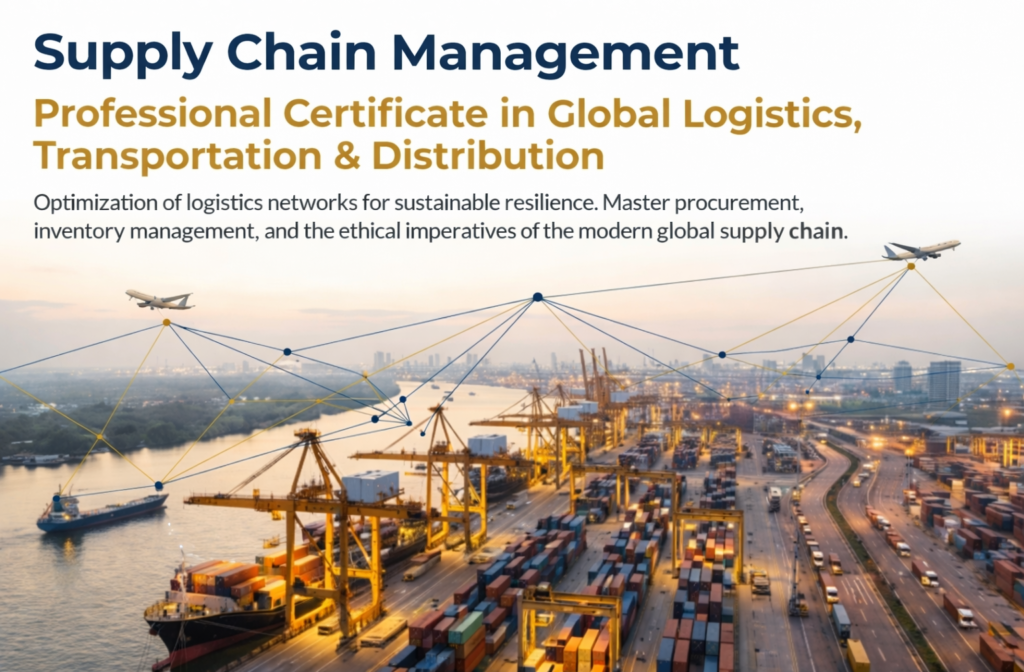
A Tier 3 expert program designed for logistics professionals and supply chain leaders who manage complex international fulfillment networks. This certificate provides a comprehensive methodology for multimodal transportation strategy, international trade compliance, distribution network design, and financial logistics modeling. Participants gain the strategic, analytical, and regulatory expertise required to optimize global flows while mitigating risk and reducing Total Landed Cost (TLC).
Core Focus
Key Skills Mastered
Certification Deliverable
Participants must develop and defend a Final Strategic Logistics Blueprint, which includes:
Target Roles: VP of Global Logistics, Transportation Manager, Global Trade Compliance Manager, Director of Distribution
Prerequisites: 5+ years of experience in logistics, transportation, or supply chain operations, Foundational understanding of supply chain and inventory concepts
Duration: 8-week program (~85 instructional hours)
Program Overview
A Tier 3 expert program designed for logistics leaders, supply chain engineers, and analysts responsible for designing and optimizing end-to-end distribution networks. The program builds advanced quantitative capability in facility location modeling, transportation optimization, financial evaluation (TCO/NPV), and resilience planning to ensure logistics infrastructure supports both cost leadership and superior service levels.
Core Focus
Key Skills Mastered
Certification Deliverable
Participants must complete and defend a Final Strategic Network Blueprint, including:
Target Roles: VP of Logistics, Network Design Manager, Senior Transportation Director, Supply Chain Strategy Consultant
Prerequisites: 5+ years of experience in logistics, transportation, or supply chain analysis, Strong quantitative and Excel modeling skills
Duration: 8-week expert program (~85 instructional hours)
Program Review
This 12-week program is an Expert & Leadership Certificate (Tier 3) designed for experienced professionals (Manufacturing Engineers, Operations Managers, Quality Managers) ready to lead and execute high-impact Continuous Improvement (CI) projects.
Core Focus: Lean Methodology and Six Sigma DMAIC Roadmap (Green Belt Alignment)
The curriculum is explicitly aligned with the ASQ Lean Six Sigma Green Belt Body of Knowledge and focuses on mastering the integration of Lean systems with the Six Sigma DMAIC roadmap to solve complex operational challenges and deliver measurable financial ROI.
Key Outcomes Mastered:
Key Outcome | Description |
DMAIC Execution | Learning to execute the DMAIC (Define, Measure, Analyze, Improve, Control) roadmap to solve complex operational problems and establish process capability (Cp, Cpk). |
Advanced Analysis | Conducting an Advanced Value Stream Analysis (VSA) to identify non-value-added steps and applying fundamental Statistical Process Control (SPC) and Measurement System Analysis (MSA) to validate data and root causes. |
Lean System Design | Implementing sophisticated Lean systems, including Total Productive Maintenance (TPM), Just-in-Time (JIT) flow, Heijunka (level loading), and Mistake-Proofing (Poka-Yoke). |
Control & Sustaining Change | Developing comprehensive Control Plans, implementing Standard Work, and using Change Leadership techniques to secure buy-in and sustain improvements. |
Certification Deliverable:
The final assessment is a Final Applied CI Project (real or simulated DMAIC project), which requires submission of a verified root cause analysis, a quantified ROI report, and a comprehensive control plan, demonstrating the statistical rigor required for the Lean Six Sigma Green Belt designation.
Detail | Specification |
Target Roles | Manufacturing Engineers, Operations Managers, Quality Engineers, CI Specialists |
Prerequisites | 3+ years’ experience in manufacturing or operations |
Duration | 12 Weeks (130 Hours) |
Program Review
This Executive Certificate (Tier 4 Technology-Enabled Execution Executive Leadership) is designed for C-suite and Senior Leaders (CEO, COO, CIO, CDO) who are accountable for the strategy, funding, and governance of major Industry 4.0 and Smart Factory initiatives.
Executive Mandate: Strategy, ROI, and Governance
This is a strategic, non-technical program focused on delivering return on investment (ROI), designing executive governance structures, and leading large-scale organizational transformation to achieve profitable execution of digital manufacturing strategy.
Key Outcomes Mastered:
Key Outcome | Description |
Financial Mastery | Quantifying and defending massive capital expenditures (CapEx) for Digital Twin and AI platforms using Total Cost of Ownership (TCO) and advanced ROI financial models tailored for Industry 4.0 technologies. |
Strategy & Roadmap | Formulating a comprehensive, multi-year Smart Factory Roadmap that directly links digital initiatives to core business KPI (profitability, agility). |
OT Convergence & Risk | Designing resilient IT OT Governance Models to manage data ownership, integration, and mitigate enterprise-level industrial cybersecurity risk. |
Transformation Leadership | Leading the necessary Cultural and Organizational Transformation at the executive level to align the board, IT, and operations leadership teams and ensure sustained digital adoption. |
Certification Deliverable:
The capstone project requires the development and defense of a comprehensive Executive Smart Factory Strategy Blueprint, including the ROI model and IT/OT governance plan, validating the ability to articulate, quantify, and defend a comprehensive digital strategy to the board.
Detail | Specification |
Target Roles | CEO, COO, CIO, VP Operations, Senior Executives |
Duration | 8 Weeks (Executive Format) |
Prerequisites | Significant executive experience and strong business acumen |
Program Review
This 6-week program is a Practitioner Application Certificate (Tier 2) designed for Engineers, Technicians, and Project Managers seeking the core concepts and practical steps for implementing Digital Twin (DT) technology in industrial environments.
Core Focus: Bridging Physical Assets to Digital Models via IIoT
The program focuses on the fundamental components of a functioning DT: physical assets, the IIoT data connection, the model, and the use case (e.g., predictive maintenance). Graduates learn to specify data needs, contribute to deployment teams, and effectively communicate the value of Digital Twins.
Key Outcomes Mastered:
Key Outcome | Description |
DT Taxonomy & Concepts | Defining the difference between a Digital Twin, Digital Shadow, and Simulation and articulating their industrial value and primary use cases (e.g., predictive maintenance). |
IIoT Data Specification | Mastering the specification of IIoT data requirements (sensor type, frequency, latency) needed to create a functioning DT for a given asset and performing data mapping to model attributes. |
Model Building & Visualization | Utilizing conceptual DT tools to integrate a 3D model with a live data stream for real-time visualization, dashboard setup, and basic alarming. |
Simulation & Value Realization | Applying foundational modeling concepts to run simple “what-if” scenarios to predict asset behavior or test process changes, and developing a preliminary DT Feasibility Report for business justification. |
Certification Deliverable:
The final assessment is a Final Digital Twin Design Project (Feasibility Report), requiring the correct specification of IIoT data and the articulation of business justification for two industrial use cases.
Detail | Specification |
Target Roles | Manufacturing Engineers, IIoT Implementation Specialists, Maintenance Technicians |
Prerequisites | Foundational IIoT concepts and basic CAD modeling understanding |
Duration | 6 Weeks (60 Hours) |
Program Review
This Practitioner Application Certificate (Tier 2) is a 7-week, 70-hour program designed for Engineers, Project Managers, and Financial Analysts (2+ years’ experience) who need to master the financial dimension of technical decision-making, bridging Engineering Economics with modern cost management practices.
Core Focus: Quantifying, Justifying, and Controlling Capital Costs (CapEx)
The program equips graduates to transform technical specifications into financial proposals that secure investment. Key areas include Time Value of Money (TVM), Discounted Cash Flow (DCF) analysis, Total Cost of Ownership (TCO), and advanced cost modeling.
Key Outcomes Mastered:
Key Outcome | Description |
Project Evaluation | Conducting comprehensive financial evaluations of alternative projects using metrics such as Net Present Value (NPV), Internal Rate of Return (IRR), and Payback Period. |
Cost Modeling | Developing a detailed Total Cost of Ownership (TCO) model for complex engineering assets, accounting for acquisition, operating, maintenance, and disposal costs. |
Cost Estimation | Employing various cost estimation techniques (parametric, analogous, bottom-up) and Activity-Based Costing (ABC) to establish accurate budgets and control spending. |
Financial Justification | Applying the principles of Time Value of Money (TVM) and constructing a compelling Capital Expenditure (CapEx) Report that translates technical needs into clear financial benefits and risks for executive review. |
Certification Deliverable:
The final assessment requires the submission and defense of a comprehensive Capital Asset Justification Report (Final CapEx Justification Project), including a detailed TCO model, NPV/ IRR analysis, and a clear recommendation.
Detail | Specification |
Target Roles | Manufacturing Engineers, Project Managers, Cost Estimators, Financial Analysts |
Instructional Hours | 70 Hours of structured content & labs |
Duration | 7 Weeks |
Program Overview
This 10-week program is designed for senior professionals (Director of Regulatory Affairs, CISO (Healthcare), HIPAA Compliance Officer) who must manage the complex intersection of healthcare delivery, regulatory compliance, and technology governance.
Core Focus: Regulatory Risk Mitigation and HIPAA Architecture
The program provides an advanced, integrated framework for mastering FDA device regulation, HIPAA security and privacy rules, and clinical cybersecurity, equipping leaders to mitigate multi-million-dollar regulatory penalties and protect patient safety.
Key Skills Mastered:
Skill Focus | Description |
Regulatory Mastery | Mastering the FDA regulatory pathways for medical devices (510(k) process) and software (SaMD) and applying the necessary Quality System (ISO 13485) requirements. |
HIPAA & Data Architecture | Architecting a robust HIPAA Security and Privacy Governance framework, ensuring data de-identification, access control, and breach response readiness across EHR and cloud platforms. |
Clinical Cybersecurity | Developing a comprehensive Clinical Cybersecurity Strategy to assess and manage vulnerabilities in networked medical devices and Hospital IoT systems. |
Risk Management | Applying formal Risk Management Analysis (RMA) techniques to the entire technology lifecycle, prioritizing risks based on probability of failure and potential impact on patient safety. [Image of Risk Management Analysis Matrix in Healthcare] |
Certification Deliverable:
Certification requires the defense of a comprehensive Technology Governance & Compliance Blueprint, including an RMA for a networked device, a detailed HIPAA compliance architecture, and a CAPA (Corrective and Preventive Actions) plan for a simulated system failure.
Detail | Information |
Target Roles | Director of Regulatory Affairs, Chief Information Security Officer (CISO) (Healthcare), HIPAA Compliance Officer, Quality Assurance VP (Medical Device) |
Program Overview
This 10-week, highly specialized program is designed for data scientists, engineers, and clinical researchers (AI Diagnostics Developer, ML Engineer (Medical Device)) focused on the practical application of AI and ML in diagnostics.
Core Focus: Regulatory-Grade Model Development and Clinical Validation
The program provides deep technical mastery in the entire ML lifecycle, specifically tailored to building, validating, and deploying regulatory-grade predictive models for medical imaging (Radiomics) and complex clinical data, ensuring reliability, explainability, and ethical governance.
Key Skills Mastered:
Skill Focus | Description |
Deep Learning for Imaging | Gaining deep technical proficiency in Deep Learning (DL) architecture (e.g., CNN U-Net) for medical image segmentation and classification (Radiomics). |
Validation and Ethics | Mastering model validation metrics (AUC, Sensitivity, Specificity), performing robust bias mitigation, and implementing Explainable AI (XAI) to support physician trust. |
Regulatory-Grade Development | Mastering the ML lifecycle tailored for Software as a Medical Device (SaMD), including a conceptual FDA 510(k) submission strategy and HIPAA compliance. |
Data Curation Strategy | Learning to design and execute data labeling, curation, and augmentation strategies to prepare complex, high-dimensional medical data for high-performing AI models. |
Certification Deliverable:
Certification requires the defense of a comprehensive AI Diagnostic System Proposal, including a fully validated ML model (code and metrics), a bias mitigation report, and the conceptual FDA 510(k) submission strategy.
Detail | Information |
Target Roles | AI Diagnostics Developer, Clinical Data Scientist, ML Engineer (Medical Device), Regulatory Affairs Specialist (AI Focus) |
Program Overview
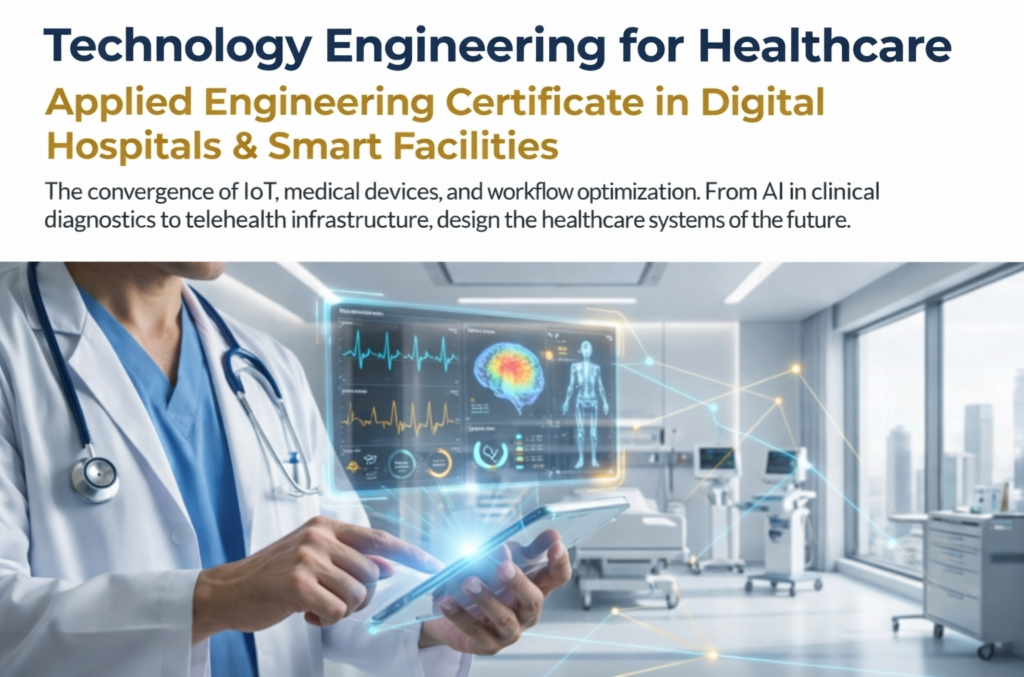
This 10-week, highly specialized program is designed for engineers, IT leaders, and facilities managers (Hospital IT Architect, Director of Clinical Engineering) responsible for the technical infrastructure of modern healthcare environments.
Core Focus: HIoT Architecture, Cybersecurity, and RTLS Optimization
The program focuses on applying rigorous systems engineering and Industry 4.0 principles to hospitals, equipping leaders to architect the digital foundation for a smart hospital, ensuring seamless integration, operational efficiency, and strict adherence to patient safety and regulatory standards (HIPAA).
Key Skills Mastered:
Skill Focus | Description |
HIoT Architecture | Architecting a secure, scalable Hospital IoT (HIoT) network, managing the convergence of BMS (Building Management System) and medical device data across a segmented network. |
RTLS & Workflow Optimization | Designing and implementing Real-Time Location Services (RTLS) solutions to optimize patient flow, track critical assets, and improve staff efficiency. |
Clinical Cybersecurity | Developing a comprehensive Clinical Cybersecurity Strategy tailored for OT (Operational Technology) environments, managing the unique risks of networked medical devices and BMS systems. |
Financial Justification | Formulating a technology CapEx justification and roadmap for a new Smart Facility, quantifying the ROI from energy savings and operational efficiency gains. |
Certification Deliverable:
Certification requires the defense of a comprehensive Digital Hospital Infrastructure Blueprint, including the HIoT network architecture, clinical cybersecurity policy, RTLS implementation plan, and a CapEx ROI model.
Detail | Information |
Target Roles | Hospital IT Architect, Director of Clinical Engineering, Smart Facility Manager, Healthcare IoT Strategist |
Program Review
This 8-week program is an Advanced Engineering & Research Program (Tier 4) designed for elementary education leaders (Director of STEM Curriculum, Chief Academic Officer) who are tasked with strategically integrating Computational Thinking (CT) and the Engineering Design Process (EDP) into K-5 classrooms.
Core Focus: CT Integration, Age-Appropriate Pedagogy, and Systems Engineering K-5
The program provides an integrated framework for applying principles from computer science, cognitive science, and systems engineering to design authentic, age-appropriate learning experiences that build core logic and design skills early on.
Key Skills Mastered:
Skill Focus | Description |
CT & Curriculum Integration | Learning to redesign core K-5 curricula to seamlessly integrate the Five Components of Computational Thinking (Decomposition, Pattern Recognition, Abstraction, Algorithm Design, Evaluation) and align them with the Engineering Design Process (EDP). |
Advanced CT Pedagogy | Mastering age-appropriate instructional methods, including unplugged activities and visual programming environments (Scratch Jr. Conceptual), to effectively build CT competencies in early learners. |
Systems Thinking & CI | Applying engineering and Continuous Improvement (CI) principles to educational program design, including understanding Feedback Loops in Learning and Lean principles for curriculum structure. |
Assessment and Scale | Designing a system of measurable educational KPI and Assessment Rubrics to track student proficiency in both CT skills and the EDP, strategically justifying program effectiveness to stakeholders. |
Certification Deliverable:
Certification requires the successful defense of a comprehensive CT Curriculum Transformation Blueprint, which includes a revised K-5 curriculum map, a detailed professional development plan for faculty, and a set of validated CT proficiency assessment rubrics.
Detail | Information |
Target Roles | Director of STEM Curriculum, Chief Academic Officer (Elementary), Master Teacher |
Format | 8 Weeks (Intensive Cohort) |
Program Review
This advanced Graduate Diploma (Tier 3: Expert and Leadership Program) is designed for School Principals, Academic Deans, CTOs, and Department Heads who oversee the strategic outcomes, financial viability, and organizational governance of technology engineering programs.
Core Focus: Strategic Governance, Financial Engineering, and Risk Mitigation
The program focuses on applying systems leadership and financial engineering principles to transform technical programs into sustainable, high-impact assets that drive institutional growth and exceptional learning outcomes.
Key Outcomes Mastered:
Key Outcome | Description |
Financial Engineering & Funding | Mastering the use of Total Cost Ownership (TCO) Modeling and Capital Expenditure (CapEx) Justification to successfully secure multi-million-dollar investments in STEM facilities and equipment. |
Program Strategy & ALM | Formulating a cohesive 5-Year Technology Engineering Program Strategy that aligns curriculum goals with long-term Asset Lifecycle Management (ALM) planning. |
Talent Management | Gaining proven frameworks for leading, mentoring, and retaining specialized technical faculty staff, and managing organizational change for sustained technical innovation. |
Risk, Safety & Compliance | Designing robust governance, safety protocols, and regulatory frameworks (e.g., FERPA) to manage operational risk across sophisticated labs and technical infrastructure. |
Certification Deliverable:
The final assessment requires the submission and defense of a comprehensive 5-Year Technology Engineering Program Strategy and CapEx Proposal (Final Capstone Project) for an institutional setting.
Detail | Information |
Target Roles | School Principals (STEM/Engineering focus), CTOs for Educational Systems, Department Heads |
Prerequisites | 5+ years of management or leadership experience |
Duration | 12 Weeks (95Instructional Hours) |
Program Review
This 8-week program is a Specialized & Applied Program (Tier 2) certificate designed for high school STEM teachers, technology coordinators, and curriculum developers who need to implement and teach robust, hands-on engineering programs.
Core Focus: Integrated Robotics, Mechatronics, Physical Computing, and Project-Based Learning (PBL)
The curriculum provides a practical, integrated approach to both technical skills (C++/Python coding, sensors, actuators) and advanced pedagogical methods for delivering rigorous, safe, and engaging engineering experiences.
Key Outcomes Mastered:
Skill Focus | Description |
Robotics & Mechatronics | Applying foundational concepts of mechatronics, including the selection, programming, and integration of sensors (Proximity, Encoders) and actuators (Motors, Servos) for physical computing projects. |
Coding for Hardware | Utilizing basic Python or C++ to program microcontrollers (Arduino conceptual) for input/output tasks, implementing Control Loops (PID conceptual), and basic data structures for robotic control algorithms. |
Engineering Pedagogy | Designing and implementing authentic Project-Based Learning (PBL) units centered on the Engineering Design Process (EDP), ensuring curriculum alignment with NGSS and CS standards. |
Lab Governance & Funding | Developing and implementing comprehensive STEM Lab Safety Protocols and formulating equipment CapEx justification and ROI proposals, linking technical needs to funding strategy. |
Certification Deliverable:
Certification requires the successful defense of a comprehensive Robotics Curriculum Design Package (Final Applied Design Project), which must include a multi-week PBL unit plan, the EDP assessment rubric, and a detailed lab equipment CapEx ROI proposal.
Detail | Information |
Target Roles | High School Engineering Teacher, Robotics Program Director, STEM Curriculum Specialist |
Duration | 8 Weeks |
Program Review
This two-year Foundational & Practitioner Degree Program (Tier1) provides students with the integrated technical and administrative skills required to manage the technology infrastructure of modern K-12 schools and districts.
Core Focus: IT Support, Device Management, and K-12 Regulatory Compliance
The degree prepares graduates for essential roles in educational IT departments by focusing on maintaining system uptime, optimizing hardware deployment, and providing effective technical support to students, faculty, and administration.
Key Skills Mastered:
Skill Focus | Description |
IT Fundamentals & Troubleshooting | Gaining essential IT support functions, including hardware/software troubleshooting and network essentials (CompTIA A+ conceptual domains), and basic Cybersecurity Hygiene. |
Compliance Expertise | Mastering and enforcing core K-12 regulations, including CIPA (Children’s Internet Protection Act) filtering and FERPA (Family Educational Rights and Privacy Act) data privacy rules. |
Device Fleet Management | Learning to manage the deployment, inventory, and lifecycle of educational device fleets (laptops, tablets) and performing essential MDM (Mobile Device Management) tasks for 1:1 and BYOD environments. |
Pedagogical Technology | Supporting the use of technology for teaching and learning, including Learning Management Systems (LMS) and Assistive Technology (AT) Support. |
Degree Requirements & Advantage:
The program requires successful completion of 60 credit hours and a Mandatory Internship Co-op within an IT department of a K-12 school district, ensuring real-world experience and immediate job-readiness.
Detail | Information |
Target Roles | Educational text IT Technician, School District Help Desk Specialist, Technology Support Aide |
Duration | 2 Academic Years (4 Semesters) |
Total Credits | 60 Credit Hours |
Prerequisites | High School Diploma or equivalent |
Program Review
This 4-week program is a Foundational / Student course (Grades 4-7) designed to serve as the entry point for learning core logic and programming fundamentals through a visual, block-based interface.
Core Focus: Computational Programming Concepts and Logic
The program aims to develop computational literacy and mastery of the Scratch programming environment (MIT), translating large problems into smaller, solvable steps.
Key Skills Mastered:
Skill Focus | Description |
Computational Logic | Understanding flowcharts, sequence, parallelism, and decomposition to break large problems into smaller, solvable steps. |
Block-Based Coding | Mastery of the Scratch programming environment, including setting up sprites, backgrounds, and controlling motion, looks, and sound. |
Control Structures | Implementing loops (repeat, forever), conditionals (if\then\else), and variables for managing game state and data. |
Debugging | Developing systematic skills for identifying and fixing logical errors in self-created programs. |
Capstone Project: “The Interactive Game Challenge”
Students will design and build a fully interactive, multi-level game (e.g., a platformer or maze solver) complete with scoring, lives, and a final winning condition, which they will then present to the cohort.
Detail | Information |
Target Audience | Students (Grades 4-7) |
Format | 4 Weeks (Interactive Virtual Labs) |
Outcome | Master Scratch (MIT) and Computational Literacy |
Program Overview
This Tier 3: Expert & Leadership certificate equips experienced finance and sustainability professionals with the practical tools needed to integrate ESG factors into corporate finance, investment decision-making, and mandatory reporting. The program moves beyond ESG awareness to advanced application—linking sustainability risks and opportunities directly to valuation, capital allocation, and regulatory compliance.
Core Focus
ESG risk quantification and financial materiality
ESG-adjusted valuation and WACC/DCF modeling
Sustainable finance instruments (green bonds, sustainability-linked loans)
Integrated reporting and climate disclosure (GRI, SASB, TCFD, IIRC)
GHG accounting and net-zero transition planning
Key Skills Mastered
ESG-adjusted DCF and valuation analysis
Climate and transition risk integration into financial models
Materiality assessment and stakeholder-driven ESG analysis
Integrated ESG and financial reporting execution
Evaluation and structuring of sustainable finance products
Certification Deliverable
Final Integrated ESG Report Project, including a materiality assessment, ESG-adjusted DCF valuation summary, GHG emissions overview (Scopes 1–3 basics), and a TCFD-aligned governance and strategy disclosure.
Program Tier: Tier 3 – Expert & Leadership
Target Roles: ESG Analysts, Sustainability & Reporting Managers, Sustainable Finance Specialists, Investor Relations (ESG Focus), Credit & Risk Analysts
Prerequisites: Bachelor’s degree in Finance/Business or related field; solid accounting and finance fundamentals; intermediate Excel proficiency
Duration: 9 weeks (90 hours)
Delivery Format: Structured virtual learning with applied financial labs, regulatory workshops, and case studies
Program Overview
This Tier 3: Expert & Leadership certificate prepares financial advisors and wealth professionals to deliver comprehensive, client-centric financial planning aligned with CFP® certification standards. The program covers the full financial planning lifecycle—integrating investments, tax strategy, insurance, retirement, and estate planning—while reinforcing fiduciary ethics and professional client communication. Graduates gain the analytical and advisory capability required to design, implement, and monitor holistic financial plans.
Core Focus
Comprehensive financial planning process (CFP® Body of Knowledge)
Investment planning and portfolio construction (MPT)
Tax-efficient wealth and retirement strategies
Risk management and insurance planning
Estate planning fundamentals and plan integration
Ethics and fiduciary responsibility
Key Skills Mastered
Application of the CFP® financial planning process
Portfolio design using asset allocation and risk metrics
Tax and retirement planning analysis and projections
Insurance needs evaluation and risk mitigation
Client communication, documentation, and ethical decision-making
Certification Deliverable
Final Comprehensive Financial Plan Project — development and defense of a full integrated financial plan for a complex client case, covering investments, tax, insurance, retirement, and estate planning in compliance with CFP® standards.
Target Roles: Financial Advisors, Wealth Managers, Investment Planners, Client Service Associates, Insurance Professionals pursuing comprehensive planning roles
Prerequisites: Bachelor’s degree; foundational knowledge of investments; intermediate Excel proficiency
Duration: 12 weeks (120 hours total)
Program Overview
This Tier 3: Expert & Leadership diploma is designed for experienced finance professionals seeking institutional-grade expertise in investment decision-making and portfolio management. The program integrates financial economics with practical market analysis to enable graduates to construct, manage, and evaluate multi-asset portfolios while meeting fiduciary and regulatory obligations in institutional and private wealth settings.
Core Focus
Modern Portfolio Theory (MPT) and strategic asset allocation
Equity and fixed-income valuation methodologies
Derivatives usage for hedging and income strategies
Portfolio risk measurement and performance evaluation
Fiduciary duty, ESG integration, and regulatory compliance
Key Skills Mastered
Design and optimization of multi-asset portfolios aligned with client or institutional objectives
Execution of equity and fixed-income valuations using DCF, relative valuation, yield, and duration analysis
Application of risk and performance metrics (Sharpe, Treynor, Jensen’s Alpha; VaR conceptual)
Integration of derivatives into portfolios for risk management and return enhancement
Development of compliant Investment Policy Statements (IPS) and due diligence frameworks
Certification Deliverable
Final Investment Strategy Project — development and defense of a complete client or institutional investment mandate, including a formal Investment Policy Statement (IPS), strategic asset allocation, quantitative justification, and a structured risk management plan.
Target Roles: Portfolio Managers, Investment Analysts, Senior Wealth Managers, Hedge Fund Analysts, Trust Officers, Pension Fund Analysts
Prerequisites: Bachelor’s degree in finance, Economics, or a related field; strong knowledge of financial markets and accounting; intermediate Excel proficiency
Duration: 12 weeks (120 instructional hours)
Program Overview
This Graduate Diploma is designed for quantitative analysts, financial engineers, and experienced technologists seeking mastery in computational finance, derivatives pricing, and algorithmic trading. The program delivers mathematically rigorous and computationally intensive training in stochastic calculus, numerical methods, and model risk management, preparing professionals to design, implement, and validate complex financial models used in trading, risk management, and asset-liability management.
Core Focus
Key Skills Mastered
Certification Deliverable
Graduate Diploma in Financial Engineering & Computational Finance
Awarded upon successful completion of coding labs and a final Financial Engineering Project, including a full derivatives pricing model, computational implementation, and model risk validation.
Target Roles: Quantitative Analyst, Quant Developer, Model Validation Specialist, Algorithmic Strategist, Front-Office Financial Engineer
Prerequisites: Master’s degree or equivalent in Mathematics, Physics, Engineering, or quantitative field; proficiency in Python/R; strong calculus, linear algebra, and probability skills; foundational knowledge of financial markets
Duration: 12 weeks (120 instructional hours)
Program Overview
This certificate equips finance and data professionals with the applied data science and AI skills required to solve advanced financial problems. The program emphasizes hands-on Python programming, machine learning, time series analysis, and NLP to build predictive models for credit risk, trading signals, and portfolio and risk analytics—bridging financial theory with real-world computational implementation.
Core Focus
Key Skills Mastered
Certification Deliverable
Professional Certificate in Financial Data Science & AI
Awarded upon completion of coding labs and a Final Financial Data Science Project demonstrating end-to-end predictive modeling, validation, and strategic recommendations using Python.
Target Roles: Financial Data Scientist, Credit Risk Modeler, Quant Analyst (ML-focused), FinTech Developer, Fraud & AML Analyst
Prerequisites: Bachelor’s degree in finance, Data Science, Computer Science, or a quantitative field; foundational statistics and linear algebra; basic Python proficiency
Duration: 9 weeks (95 instructional hours)
To help us assist you effectively, please include the information below with your message. Your personal data will be handled in line with our Privacy Statement.
Required fields are indicated by an asterisk (*).